On October 9, 2014, I drove from the eastern shore of Maryland to the Brandywine River Museum in Chadsford, Pennsylvania. Again, there were many unpublished Wyeth works on display alongside the finished paintings on display. I saw a preliminary painting for his tempera, "Roasted Chestnuts." I believe it was the only study that he did using oil paints....
"Chestnuts," tempera
Here are many other works I had the joy to study while I was there:
"Barracoon," tempera.
"Anna Christina," tempera.
"Faraway," drybrush.
"Racoon," tempera
"Garret Room," drybrush
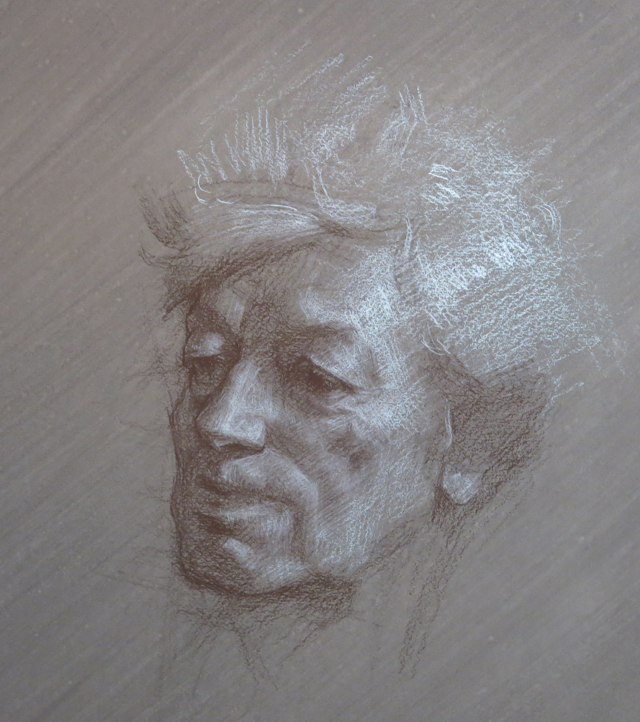
Study of Tom Clark, pencil
From the museum I took a tour of Andrew Wyeth's studio:
The famous "Do not disturb" sign on the studio door.
Wyeth's studio
Wyeth's miniature collection
The plus to the trip was to head down to Ring Road and view what is left of Mother Archie's Church just past the Kuerner's Farm:
Trip to the east coast to see The Wyeth exhibit at the Smithsonian Museum of Art in Washington D.C. on October 8, 2014.
I was amazed to see so many unpublished works. Most were preliminary studies for tempera or dry brush works. Apparently, Andrew did thousands of studies that were saved by his wife. I expect to see many more unpublished works in the years to come.
Here are a few that were in the show that we are familiar with:
Andrew Wyeth, "Frostbitten," 1962, watercolor on paper, Private Collection, copyright, Andrew Wyeth
Andrew Wyeth, "Evening at Kuerners," 1970, drybrush on paper, The Andrew and Betsy Wyeth Collection, copyright, Andrew Wyeth
Andrew Wyeth, "Springfed," 1967, tempera on masonite, Collection of Bill and Robin Weiss, copyright, Andrew Wyeth
When it is branding time, ranchers get together and help each other out. After the branding is complete, the host rancher will put on a feed for everyone who participated. It is not long before all the wild stories, gossip, and jokes(whoppers) start flying. The scene in the painting depicts when the punch line was delivered with a resounding thud! The central figure is a friend named Ed Machado who is a rancher, and saddle bronc rider who also provides "rough stock" at PRCA rodeo events.
The Haggin Museum has an impressive collection of American and European art such as William Adolphe Bouguereau's, "The Nymphaeum". And more:
Albert Bierstadt's, "Sunset in the Yosemite Valley",
Daniel Ridgway Knight's, "Noonday Meal",
Jean-Leon Gerome's, "The Artist and His Model", and much more...
Clark Gussin receiving the coveted "Best of Show" award. What could be better than having Adolphe Bouguereau's, "The Nymphaeum" as the back drop.
Participated in The 84th Statewide Exhibition hosted by the Santa Cruz Art League. It was great to exhibit with mentor and teacher Warren Chang who showcased the exhibition with his 3rd place entry: "Fall Tilling". It was a pleasure to exhibit and have my painting, "Sandhill Crescendo" juried by Master Panter, David Leffel.
"Route 41 Suite," Paintings and Drawings by Clark Gussin at the Triton Museum of Art, Santa Clara, CA
April 23, 2013-June 23, 2013. Artists reception May 10, 2013, 6-8 P.M.
My landscape painting: "Sandhill Crescendo," and my drawing: "Sabbath" were a finalists at the 2013 ARC Salon in the Landscape and Drawing categories respectively.
I have created many sketch books over the years, and I try to make it a habit to sketch everyday. I use them to record what I see in nature when I am painting outside, in my studio, a life drawing class, visiting a museum or exhibition, or just writing down my thoughts. This sketch is a copy from one of daVinci's notebooks on the human anatomy using walnut ink on toned paper with watercolor.
A sketch on location at Jughandle Beach on the Mendicino coast.
My smallest oil painting to date. The Tred Avon River is on the eastern shore of the Chesapeake Bay of Maryland. It separates Oxford and Saint Michael s.
I am currently exhibiting: California Heritage, CAC Exhibitions at the Historic Blinn House August 14 - December 1, 2010 Featuring:Elizabeth Abeyta, Larry Arbino, Darwin Avila, Jill Blaisdell, Judith Cameron, Darcie Copeland, Susan Elwart-Hall, Lynne Fearman, Terri Ford, Rodney Fuentebella, Alan Garber, Gail Gurman, Clark Gussin, Micaiah Hardison, Warren Hile, Paula Holtzclaw, Keewon Hong, Jeffrey Johnson, Janette Jones, Dee Kirkham, Olga Krimon, Josh Lee, Patricia McGeeney, Marion Melchiorre, Ning Mercer, Terry Miura, Lisa Mozzini-McDill, Joseph Napolitano, Pamela Panattoni, Roy Prinz, Pauline Roche, Roderick Smith, Robert Steele, Sal Vasquez, Laura Wambsgans, Belita William, Toni Williams and Cecily Willis.
After all these years being drawn to the sea, I painted my first seascape in oil. The subject can be found at the Point Lobos State Preserve in California. The Preserve has been a favorite place for me and my family over the years to escape and be spiritually, mentally, and physically restored. Gazing at the natural beauty of the landscape and ocean has a calming affect on the senses. A way to escape the pressures of work and life in general.
Clark Gussin’s kids knew that if their dad took them to the beach, he’d have his camera and sketchbook waiting in the car.“Wherever we went, I made sure it was a place I could work on my art.”Clark Gussin is an artist whose paintings evoke a time and place long past.Rural settings, cowboys, and farms occupy much of his work, including still life, portraits and landscapes.Like one of his major influences, Norman Rockwell, Clark’s technique is firmly rooted in Naturalism, art that depicts realistic objects in a natural setting.In spite of a resurgence of interest in Naturalism (also called Realism), when Clark was studying art, he had a hard time finding instructors who were interested in teaching it.Abstract art, along with pop art and expressionism, were the overriding aesthetics of the time.
As a boy, Clark spent summers at his grandparents’ farm in North Carolina.“It was hard work.My family plowed with mules, milked cows – I can remember them churning butter on the porch.”During the school year, Clark’s family lived in Washington D.C., where he frequently visited the National Museum.His parents noticed Clark’s talent when he was very young, and encouraged him; at the age of eleven, Clark studied oil painting at the Corcoran Gallery Art School in D.C., where he stayed for two years.Public schools at that time offered a much more comprehensive curriculum in art and music than they do today, and Clark was able to spend time learning art as part of his regular studies.
After high school, Clark was drafted and sent to Viet Nam.With his G.I. Bill, he moved to California and attended the California College of Arts and Crafts (now the California College of the Arts) in Oakland.In spite of the financial help of the Bill and a scholarship, Clark still had to work full-time to pay his tuition.“I took classes in photography, painting, illustration – I had a lot of units when I graduated!”After graduation, Clark pounded the pavement, looking for work in the Bay Area during the recession of the mid 1970s.Even so, he turned down a job as an illustrator for Rolling Stone because they planned to move to New York City just few months later.“I was a Californian by then.I would have hated New York.”Clark eventually found fulltime and freelance jobs, but when an opportunity came along for a job with IBM, he took it.“I was married with a growing family.I kept asking, ‘it pays how much?Every week?’”Clark has stayed at IBM for thirty-one years, working at a variety of jobs ranging from illustration, photography, video production, and graphic design for software interfaces.“I’ve had to reinvent myself many times,” he says.That’s what it takes to be a survivor!
Like another one of Clark’s influences, Andrew Wyeth, his choice of subjects displays a deep affection for rural people, their lives, hardships and unexpected joys revealed in intimate portraits such as Evelyn’s Daughter, which is in the permanent collection at Santa Clara’s Triton Museum.Attention to detail appears in paintings like Cherokee Matriarch, where every expression a woman has ever had shows in her deeply wrinkled face.In Sole Brothers, a pair of boots lies on a wooden patio like a couple of comical old men. In the drawing A-Maized, humble ears of field corn, arranged on a wooden table, achieve a solemn dignity: this indispensable plant has kept body and soul together for unknown centuries.
With a fulltime job and a family that includes four children, Clark is careful to carve time out of his busy schedule to paint and draw.One of his elaborately detailed drawings can take up to four months to complete; he has to be persistent to keep working on something until it’s done.“My dad used to say, ‘Everyone has the same amount of time: twenty-four hours!’”
One of Clark’s difficulties is finding the time – and energy – to take care of the business end of art: the marketing, publicizing, planning, and selling.“I just want to paint,” he sighs.“Most artists who are successful have someone else doing the business tasks for them.”For example, Andrew Wyeth’s wife Betsy was his agent and handled financial matters so Wyeth could keep painting his masterpieces.
“Strive for excellence in your work.Everything else follows that.Never stop learning and improving yourself in art. Find your voice.”Clark says that artists should look at their work and ask themselves, would someone looking at my work be able to describe me as a person without ever having met me?
It was a common setting in the rural south during the 50's and 60's when I was growing up as a young man, the small tobacco farms in southeast North Carolina. Looking back I have realized how much the people and life on rural family farms influenced my art. The curiosity and attention to detail in the rugged and worn hands of a field worker, to the faceted, weathered, and bleached boards on the side of a pack house. The juxtaposition of the natural surroundings, to the plowed furrows in the land before planting.
I have been designing and adding to a body of work called the "Route 41 Suite" for many years. I am sure that this effort will never be complete. It may end up being abandoned at the right time, like when an artist knows that a painting is finished. Where ever I live or travel, I seem to see something in my surroundings that reflect those early childhood influences.
Two drawings have been my newest additions to the suite: "Outcast", a weathered facade of a 200 year old pack house used to store cured tobacco. An old rusted, useless lantern hangs casting its shadow that covers and envelops every crack and crevice of each board it follows. Subtle as it may be, one can observe through the cracks, and see a distant landscape.
"A-Maize-D" 30 x 24 pencil
"A-Maize-D", is a random scattering of newly harvested ears of corn. The abstract play of texture and color values bring back memories of my chores, like shucking corn to feed the chickens, hogs, and mules. Though the subjects seem mundane these days, they represent volumes of wonderful memories of my childhood.
Clark Gussin was born in 1948 in Washington, D.C., and grew up there and in North Carolina. As a boy he took an early interest in art and was sent to study oil painting at the Corcoran Gallery Art School for two years. It was there and in the National Gallery that he was exposed to art history first-hand and developed a love for the style and techniques of the Old Masters. He was especially impressed by the 17th century Dutch artists and the Northern Renaissance Flemish painters, who left their imprint on his naturalistic, classic approach to painting.
Clark attended the California College of Arts and Crafts in Oakland, California, where he received a BFA degree with distinction in 1975.
Clark aspires to create beautiful, naturalistic paintings and drawings about life and humanity that expresses the beauty in the world seen through the eyes of an artist. As a result, Clark wishes to inspire, encourage, and communicate hope to those who observe, admire and collect his art.